
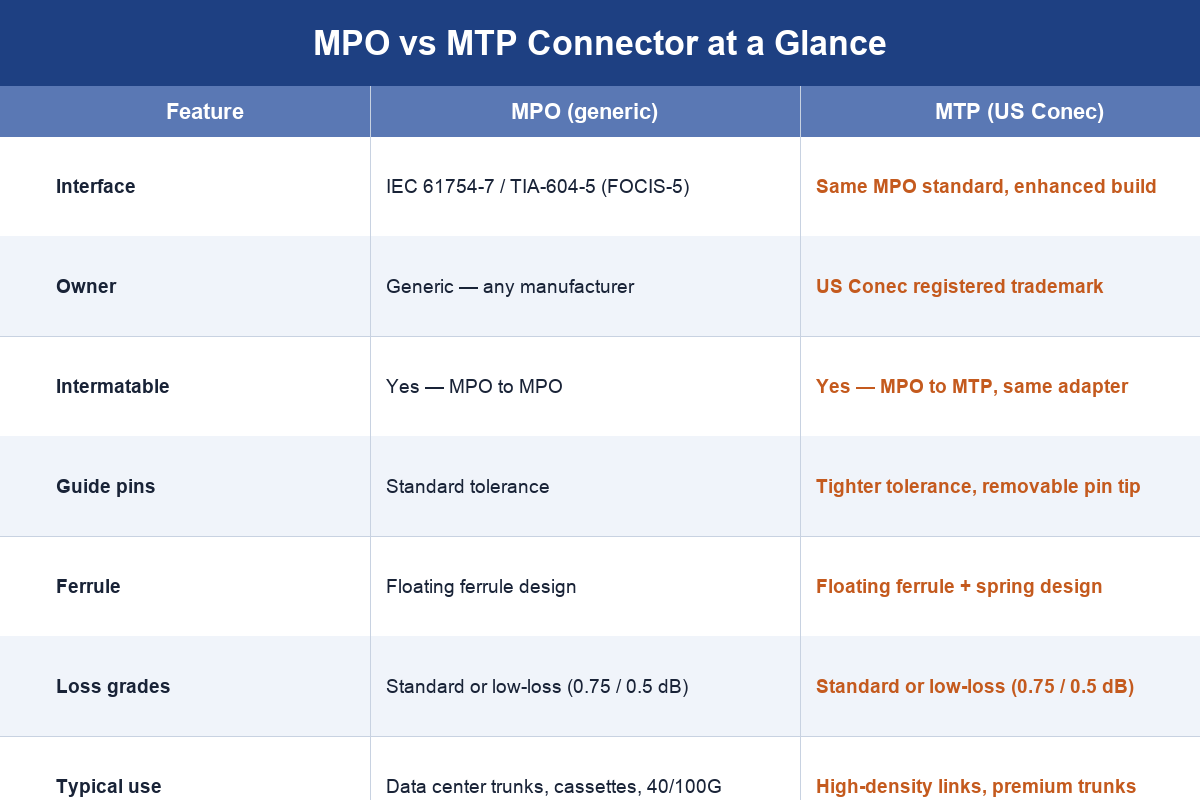
MPO vs MTP is one of those spec-sheet debates that trips up even experienced network engineers. The short answer: they are not the same thing, but they are close enough that they get used interchangeably in daily conversation. MPO is the generic multi-fiber connector defined by international standards, while MTP is a registered trademark of US Conec — an enhanced, precision-built version of the same interface. An MTP connector mates with an MPO connector through the same adapter with no tooling change, yet the two differ in construction details, consistency and price. This guide breaks down the MPO vs MTP comparison so you can decide which one belongs on your next bill of materials.
Table of Contents
What Is an MPO Connector?
MPO stands for Multi-fiber Push-On. It is a multi-fiber connector defined by the IEC 61754-7 standard and the TIA-604-5 intermateability standard (also known as FOCIS-5). Instead of terminating one fiber per ferrule like an LC or SC connector, a single MPO connector terminates up to 12 fibers — or 24 in the two-row variant — inside one rectangular ferrule, latched with a push-pull housing.
That density is exactly why the MPO connector became the backbone of modern data center cabling. A 40GBASE-SR4 or 100GBASE-SR4 transceiver, for example, receives all four (or eight) parallel lanes through one 12-fiber MPO port rather than four separate duplex LC ports. MPO connectors also appear on trunk cables, breakout harnesses, and the rear of cassette modules that split a multi-fiber trunk into individual duplex LC ports.
Two details matter when ordering any MPO-style cable:
- Gender. A “male” (pin) MPO connector carries two steel guide pins inside its ferrule; a “female” (no-pin) version has precision-aligned holes instead. Every mated pair needs exactly one male and one female end.
- Polish. Like single-fiber connectors, MPO ferrules come in UPC and APC variants, and the two must never be mixed in one link.
Keep those two variables in mind — they matter just as much later in the MPO vs MTP discussion, because both types follow the same rules.
What Is an MTP Connector?
MTP is US Conec’s branded multi-fiber connector, introduced in the 1990s as a refined version of the original MPO design. It complies fully with the same IEC 61754-7 and TIA-604-5 standards, which is why MTP and MPO components are fully intermateable — same footprint, same latch, same ferrule geometry, same adapter.
The differences are in how it is built. The MTP connector adds several design refinements that the generic MPO standard does not require:
- Removable guide-pin tip housing. The metal pin housing can be taken apart, which lets a factory re-polish or rework the ferrule instead of scrapping the connector — a durability and yield advantage in mass production.
- Tighter guide-pin tolerances. MTP guide pins are manufactured and ground to tighter diameter tolerances, so the pins center the ferrules more precisely in every mated pair.
- Floating ferrule with spring design. The ferrule floats inside the housing and is pushed by a spring, letting the mating faces stay in contact even when the connector housing takes mechanical stress from cable pull or panel movement.
- Integrated options. US Conec offers variants such as elliptical-guide-pin designs for APC and pin-averaging combinations aimed at improving multi-fiber alignment consistency.
In other words, every MTP connector is an MPO-compatible connector, but not every MPO connector delivers MTP-level consistency. That asymmetry is the heart of the MPO vs MTP question.
MPO vs MTP: The Real Differences
So what changes when you pay for the branded version? In practice, the MPO vs MTP differences fall into three buckets: build precision, optical performance consistency, and supply-chain factors.
Guide Pins and Assembly Precision
Multi-fiber connections live or die on lateral alignment. Twelve fibers, each around 125 microns of cladding, must all land within a few microns of their counterparts in the opposite ferrule — the guide pins do that centering. Generic MPO pins are produced to the tolerance the standard requires; MTP pins are ground to a tighter tolerance and made from a harder material, so they hold that precision over hundreds of mate cycles instead of wearing into a looser fit. For a link that gets re-mated regularly during maintenance, that difference compounds over time.
Insertion Loss and Return Loss Performance
Both connector families are sold in two performance grades. Standard-grade MPO and MTP connectors are typically specified around 0.75 dB maximum insertion loss, while low-loss grades are typically specified at 0.5 dB or better — the exact numbers vary by supplier, so always read the datasheet rather than assuming. Return loss follows the polish type: APC ferrules typically achieve 60 dB or better on single-mode links, UPC ferrules around 50 dB or better, and multimode PC ferrules are typically specified at 20 dB or better.
What MTP’s construction buys you is not a lower theoretical limit but a tighter distribution around it. Because the pins, ferrule float and spring design control alignment more consistently, a production batch of low-loss MTP connectors clusters closer to its specification than a comparable batch of commodity MPO connectors. On a long 24-fiber trunk that passes through several mated pairs, that margin is what keeps the channel inside its loss budget.
Availability, Price and Supply
Genuine MTP connectors come only from US Conec and its licensed supply chain, so an “MTP cable” means the manufacturer bought real US Conec components. Generic MPO connectors are produced by many factories worldwide at a wide range of quality levels — which is both an advantage (competitive pricing, multiple sources) and a risk (variable consistency between vendors). The price gap between a quality generic MPO assembly and an MTP-based assembly has narrowed over the years, and on a large project it is usually small compared with the cost of troubleshooting marginal links later.
MPO vs MTP in the Data Center: Where Each One Fits
In real deployments, the MPO vs MTP choice is less about connector politics and more about link class. Both connector types appear throughout the same data center fiber cabling solutions, and a single row often mixes them at different points.
- Trunk cables (12/24 fiber, 40/100/400G backbones). These are the long-lived, high-density assets of the structured cabling plant. Because trunks carry many aggregated channels and get re-mated rarely, this is where the consistency of MTP-based assemblies pays off most — and where most premium trunks are specified.
- Cassettes and breakout harnesses. Cassette modules convert MPO or MTP trunks to duplex LC ports at the switch. Either connector type works here; many operators simply match the trunk’s brand to keep gender and polarity documentation simple.
- Short patch runs inside a rack. For a meter-length MPO patch cord between a cassette and a transceiver, a quality standard-grade MPO assembly is usually sufficient, and its lower cost is a legitimate saving.
When you are browsing MPO and MTP trunk cable assemblies, check that the supplier states the loss grade, gender and polarity method for every SKU — that documentation matters more than the logo on the connector housing.
How to Specify an MPO or MTP Cable Without Regret
Whatever brand you land on in the MPO vs MTP decision, order failures almost always come from ambiguous line items rather than the connector itself. Before signing off a purchase, confirm five things:
- Fiber count. 12-fiber is the default for parallel optics and most trunks; 24-fiber (two-row) doubles density for 400G and backbone runs.
- Gender at each end. Follow your polarity plan: in most Method B designs, one end is male and the other female. Writing “MPO” alone without gender is the classic ordering mistake.
- Polish type. UPC (blue housing) for most multimode and single-mode links; APC (green housing) where return loss is critical, such as analog RF or PON uplinks. Never mix APC and UPC in one link.
- Loss grade. State standard or low-loss explicitly, with the dB figure you expect on the datasheet.
- Polarity method (A, B or C). The whole 12-fiber pair must follow one method consistently, or the transmit and receive lanes will never line up.
A supplier who answers those five questions without prompting is usually a supplier whose factory controls its process well — which matters more in multi-fiber cabling than in almost any other connector category.
MPO vs MTP: Frequently Asked Questions
Can an MTP connector mate with an MPO connector?
Yes. MTP is fully intermateable with generic MPO under IEC 61754-7 / TIA-604-5. You can plug an MTP cable into an MPO adapter, an MPO patch cord into an MTP cassette, or any combination, using the same standard MPO coupler. Just respect the usual rules: one male and one female per mated pair, and never mix UPC with APC.
Is MTP worth the price premium?
For long-haul 12/24-fiber trunks, high-density deployments and links near their loss budget, yes — the tighter tolerance and more consistent batch performance directly reduce the risk of marginal channels. For short intra-rack patch cords and modest-density builds, a quality generic MPO assembly typically does the same job for less. The MPO vs MTP trade-off is essentially consistency versus cost, and the right answer changes with link length and density.
Which one should I put on my bill of materials?
Specify whichever your polarity and loss-budget documentation assumes, and be explicit about grade and gender. If your drawings say “MTP” but you plan to source equivalent generic MPO assemblies, note the required loss grade so substitutes can be evaluated on performance rather than name. Either way, the physical link works the same.
High-density multi-fiber cabling rewards careful specification — and punishes vague ones. If you are planning a 40G, 100G or 400G migration and need trunks, cassettes or VSFF patch cords built to a documented loss grade, our data center fiber cabling solutions page is a good place to start, or reach out to the team for a quotation matched to your polarity plan.