
Choosing among the main PLC splitter types — bare fiber, ABS box, mini steel tube and cassette — comes down to one question: where will the splitter physically live in your network? A bare splitter suits a splice closure deep in the outside plant; an ABS box suits a cross-connect cabinet; a mini steel tube suits tight enclosures; and a cassette suits rack-mounted distribution frames. Below we cover how each package is built, expected loss by split ratio, and how to match the right one to each installation point.
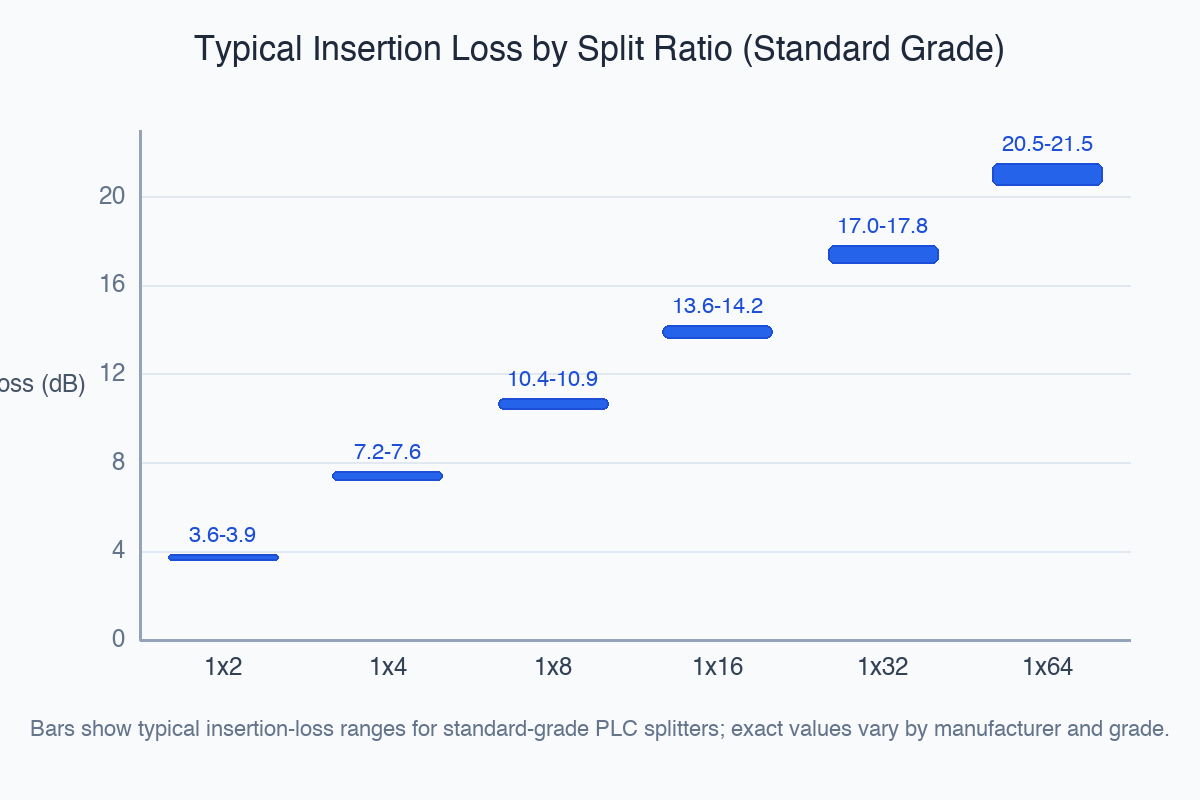
Table of Contents
- What Is a PLC Splitter and Why Does the Package Matter?
- The Four Common PLC Splitter Types
- Split Ratios and Insertion Loss: What to Expect
- How to Match a PLC Splitter Type to Your Installation
- Spec Checklist Before You Order
- FAQ
- Wrapping Up
What Is a PLC Splitter and Why Does the Package Matter?
A PLC splitter (planar lightwave circuit splitter) is a passive optical component that divides one input signal into multiple output fibers with an even power split — the workhorse of every PON network. Inside, a quartz-based PLC chip performs the splitting; outside, the chip is packaged with input and output pigtails and some form of housing. The lightwave circuit technology itself is standardized at the component level under recommendations such as ITU-T G.671, which covers the transmission characteristics of passive optical components.
Here is the part that trips up a lot of first-time buyers: the chip inside a 1×8 splitter is essentially the same whether it ships as a bare splitter, an ABS box, a mini steel tube or a cassette. What changes between the PLC splitter types is the mechanical protection, the fiber management, the connectorization, and therefore where the unit can be installed and how fast it can be deployed. Choosing the wrong package does not usually make the network “not work” — it makes the installation slower, bulkier or harder to maintain than it needed to be.
The Four Common PLC Splitter Types
Most catalogs, including ours, group PLC splitter offerings into four package families. Understanding the boundaries between them makes the conversation with your supplier much shorter.
1. Bare Fiber PLC Splitter
A bare splitter is the PLC chip and its pigtails with minimal protection — essentially the chip in a small substrate with 250 µm or 900 µm buffered fibers coming out. It has no connector and no rigid housing, so it is the smallest and usually the most economical option. Bare splitters are designed to be spliced (typically by fusion) inside a splice closure, a terminal box, or directly onto drop cables. Because the fibers are unprotected until they are spliced into something, they are an installer’s component rather than a plug-and-play product.
Choose a bare PLC splitter when you have skilled splicing labor on site, when space inside the closure is extremely tight, or when you want to minimize connector interfaces in the outside plant. They are also the natural choice for OEM builds where the splitter is integrated into someone else’s enclosure.
2. ABS Box PLC Splitter
The ABS package puts the splitter inside a molded plastic box (ABS is the common engineering plastic used) with adapter ports or stub connectors on the output side. This is the most widely deployed package for outdoor and building-entry points in FTTH networks: the box gives the chip mechanical protection and strain relief, and the output legs can be terminated with SC/APC or LC connectors so field crews can plug instead of splice.
An ABS box splitter mounts with tabs or screws into cross-connect cabinets, outdoor cabinets, and distribution boxes. If your deployment plan has a defined cabinet or box at every splitter point, an ABS box PLC splitter is almost always the default answer. The trade-off is bulk: an ABS package is noticeably larger than a steel tube, so verify the internal dimensions of your enclosure before committing to a ratio like 1×32 or 1×64.
3. Mini Steel Tube PLC Splitter
The mini steel tube (also called mini module or mini package) wraps the chip and pigtails in a slim stainless-steel sleeve — commonly around 3 mm in diameter and a few centimeters long, though exact dimensions vary by manufacturer. Its selling point is footprint: it fits into small closures, riser boxes, aerial drop terminals and compact ONT-adjacent locations where even a small ABS box would not fit. The tube also shields the fiber against lateral pressure, which helps in congested trays.
Mini tube splitters usually arrive with 900 µm loose-tube pigtails and are spliced or connectorized on site. They are the go-to package for space-constrained FTTH terminals and for retrofitting splitter capability into enclosures that were never designed for splitters.
4. Cassette (LGX) PLC Splitter
A cassette or LGX-style package houses the splitter in a metal or plastic box with front-facing adapter panels, sized to slide into a standard rack unit, patch panel, or fiber distribution frame slot. Cassette splitters are fully connectorized on both sides — patch in, patch out — so they are the fastest to deploy and the easiest to replace: a damaged unit swaps out in minutes without any splicing.
This package belongs indoors, in controlled environments: central offices, data-center-style racks, campus MDF/IDF rooms, and FTTH buildings where splitters terminate in structured panels. Where a cassette splitter needs to live outdoors instead, it typically slots into sealed fiber optic distribution boxes designed to accept plug-and-play modules.
Split Ratios and Insertion Loss: What to Expect
Whatever the package, the optical budget is driven by the split ratio. A PLC splitter divides power evenly, so the theoretical floor on insertion loss is 10 × log₁₀(N) decibels for N outputs — 3 dB for 1×2, 6 dB for 1×4, and so on. Real devices add excess loss, connector loss and uniformity spread on top of that. Industry-typical insertion loss ranges for standard grades look roughly like this:
- 1×2: about 3.6–3.9 dB typical
- 1×4: about 7.2–7.6 dB typical
- 1×8: about 10.4–10.9 dB typical
- 1×16: about 13.6–14.2 dB typical
- 1×32: about 17.0–17.8 dB typical
- 1×64: about 20.5–21.5 dB typical
Uniformity — how evenly the power is split across outputs — is the second number to watch, and reputable datasheets quote it for every ratio. Ask your supplier for a datasheet per batch rather than per product family; good manufacturers can provide test data for the specific units shipping to you.
How to Match a PLC Splitter Type to Your Installation
The fastest way to choose is to walk the link from the OLT to the subscriber and ask where the split happens, what housing exists at that point, and who will install it:
- Split at a cross-connect or outdoor cabinet: ABS box, connectorized outputs if crews prefer plugging, bare stubs if splicing is standard practice in the region.
- Split inside a small closure or drop terminal: mini steel tube — size is the deciding factor.
- Split in a rack, ODF or building MDF: cassette/LGX — speed of deployment and future replacement outweigh the higher unit cost.
- Split inside a splice closure with splicing crews on the job: bare fiber — lowest cost and lowest profile.
- Two-stage splits (central 1×4 plus pedestal 1×8, for example): plan the cascade first, then pick packages per location; cascading changes the loss budget and the enclosure count.
A practical note on connectors: for FTTH outside plant, SC/APC is the common interface in most markets because return loss matters in PON with analog video overlays or high-speed upstream; LC/UPC shows up more in indoor racks. Confirm connector polish and footprint with your team before ordering, because changing a connectorized package later is a reorder, not a field fix.
Spec Checklist Before You Order
Before sending an RFQ for any of the PLC splitter types, pin down these items so quotations are comparable:
- Split ratio and package: e.g., 1×8 ABS box, 1×16 cassette, 1×32 mini tube.
- Connector types on input and output: SC/APC, SC/UPC, LC/UPC or unterminated pigtails; note the fiber length of the legs.
- Loss and uniformity grades: standard (Grade C per common industry grading) or premium (Grade B) — tighter uniformity costs more but simplifies the link budget.
- Insertion loss and return loss limits in writing: the datasheet numbers, not marketing copy.
- Operating temperature range: outdoor deployments need -40 °C to +85 °C capable units; indoor racks can accept a narrower range.
- Enclosure fit: the actual internal dimensions of the cabinet, box or panel the unit must land in — this is where mini tube vs ABS decisions get settled.
- Compliance and test reports: batch test data, and intermating/ durability requirements if the units plug into panels that get reconfigured often.
FAQ
Are the four PLC splitter types optically different?
No. The PLC chip and its optical performance are the same; the package changes mechanical protection, connectorization and mounting. Optical differences come from the split ratio and the grade you buy, not from bare vs ABS vs tube vs cassette.
Which PLC splitter type is cheapest?
Bare fiber splitters are typically the lowest unit cost, but they require splicing labor and suitable closures on site. When you count installation time, an ABS box or cassette can be the cheaper option overall on labor-heavy projects.
Can I mix packages in one network?
Absolutely, and most real networks do: a 1×4 cassette in the central office rack cascading to 1×8 ABS boxes in cabinets, with mini tubes in tight drop terminals. What matters is that each package matches its physical location and that the combined loss stays inside your link budget.
How long do PLC splitters last?
As passive components with no electronics, quality PLC splitters are designed for decades of service. What actually shortens their life is mechanical abuse — crushed pigtails, over-bent fibers, contaminated connectors — which is one more reason the package should match the environment.
Wrapping Up
Selecting among the PLC splitter types is a logistics decision as much as an optical one: match the package to the enclosure, the crew’s skill set, and the maintenance plan, and let the split ratio set the loss budget. If you are comparing packages and ratios for an upcoming FTTH or PON project, browse our PLC splitter product category to see bare, ABS box, mini steel tube and cassette options in one place, or send us your split plan and we will recommend a configuration with a datasheet-backed loss budget.