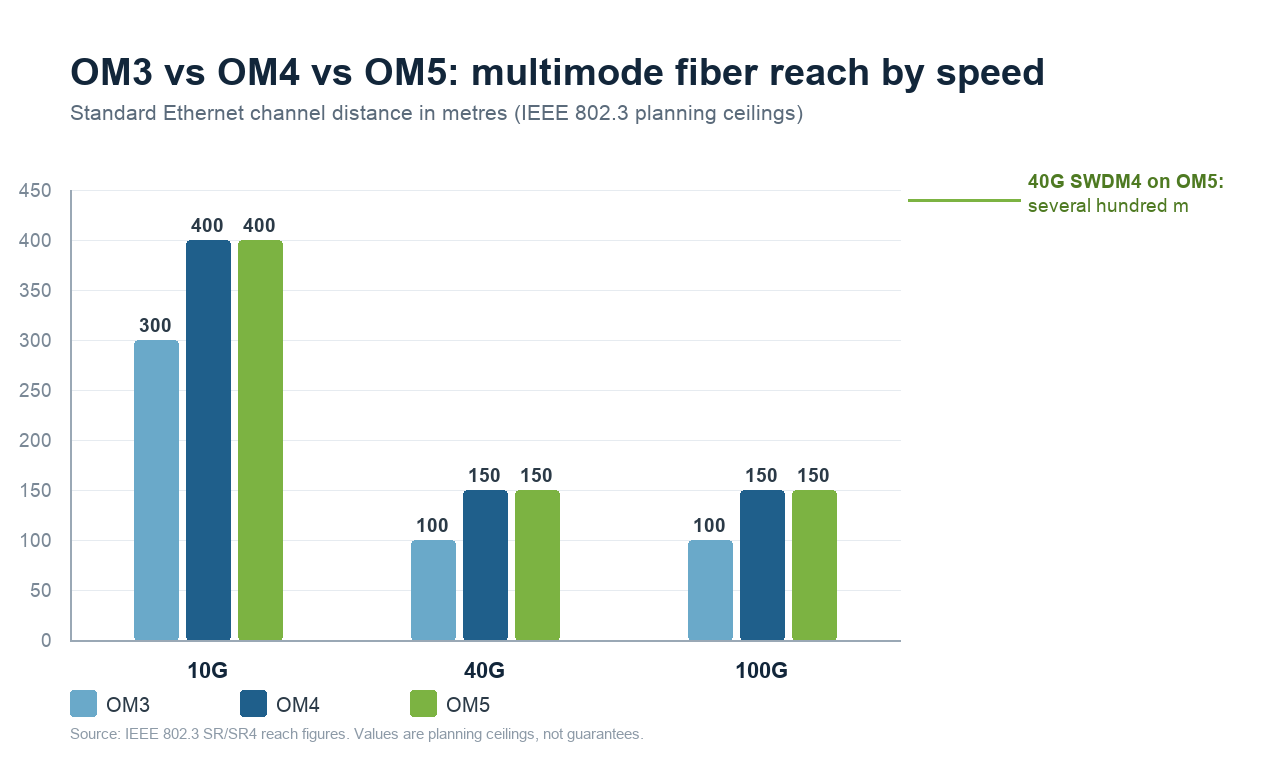
The short answer on OM3 vs OM4 vs OM5 is about reach and wavelength, not raw bandwidth. OM3 carries 10G to 300 m and 40G/100G parallel optics to 100 m. OM4 stretches those distances to 400 m and 150 m on the same 50/125 µm core. OM5 matches OM4 for parallel optics but widens the usable spectrum so shortwave division multiplexing (SWDM) can push 40G well beyond 400 m. For most in-building backbones, OM4 is the pragmatic default; OM5 earns its premium only when SWDM or a single fiber type across a mixed estate is part of the plan.
In this guide
What OM3, OM4 and OM5 actually are
All three are multimode fibers with a 50 µm core and 125 µm cladding, optimized for 850 nm vertical-cavity surface-emitting lasers. The OM designation comes from ISO/IEC 11801 and the TIA-492AAxx standards, which rank grades by minimum modal bandwidth and, from OM5 onward, by usable wavelength range.
OM3: laser-optimized multimode
OM3 replaced the older 62.5 µm OM1 and 50 µm OM2 fibers in gigabit and 10-gigabit links. Its minimum effective modal bandwidth (EMB) at 850 nm is 2000 MHz·km, enough for 10GBASE-SR at 300 m and for 40GBASE-SR4 or 100GBASE-SR4 at 100 m. It is usually jacketed in aqua and remains the most common grade in buildings wired before roughly 2012.
OM4: the same glass, tighter control
The OM3 vs OM4 difference is bandwidth headroom. OM4 keeps the 50/125 µm geometry but specifies a minimum EMB of 4700 MHz·km at 850 nm, which raises 10G reach to 400 m and 40G/100G reach to 150 m. OM4 is normally aqua as well, sometimes violet. Because OM3 and OM4 share a jacket color, the print legend is the only reliable field identifier — a detail that matters when auditing existing risers.
OM5: wideband multimode
OM5 (also written WBMMF) is an OM4-class fiber with an added bandwidth requirement in the 953 nm window — a minimum EMB of 2470 MHz·km — so it can carry four coarse wavelength-division channels at 850, 880, 910 and 940 nm. Short-reach 40G and 100G SWDM links use those four lanes instead of parallel fiber pairs. OM5 is jacketed in lime green and is fully backward compatible with OM3 and OM4 optics.
OM3 vs OM4 vs OM5 distance and speed chart
The table uses standard Ethernet reach figures from IEEE 802.3 and from typical transceiver datasheets. Treat them as planning ceilings, not guarantees: every mated pair of connectors, splice and dirty endface removes margin.
| Fiber grade | Core / cladding | Min. EMB at 850 nm | 1G (1000BASE-SX) | 10G (10GBASE-SR) | 40G (SR4) | 100G (SR4) |
|---|---|---|---|---|---|---|
| OM2 | 50 / 125 µm | 500 MHz·km | 550 m | 82 m | — | — |
| OM3 | 50 / 125 µm | 2000 MHz·km | 550 m | 300 m | 100 m | 100 m |
| OM4 | 50 / 125 µm | 4700 MHz·km | 550 m | 400 m | 150 m | 150 m |
| OM5 | 50 / 125 µm | 4700 MHz·km (2470 at 953 nm) | 550 m | 400 m | 150 m | 150 m |
Read the chart by column, not by headline. If the longest channel is under 100 m and stays at 10G, OM3 and OM4 perform identically. The OM3 vs OM4 gap only opens once a link passes 100 m at 40G/100G, or 300 m at 10G. That is why “OM4 is better” is true in the datasheet but not always in the bill of materials.
Where 100G and 400G land
100GBASE-SR4 reaches 100 m on OM3 and 150 m on OM4/OM5 over an 8-fiber MPO channel; 400GBASE-SR8 and 400GBASE-SR4.2 use more lanes at similar multimode fiber distance, which is why multimode 400G is essentially a within-row technology. Beyond roughly 150 m at 400G, the design moves to single mode — that crossover is the real decision point in most data center projects, and beyond it the OM3 vs OM4 vs OM5 comparison becomes academic.
Why the reach numbers differ: EMB and wavelength windows
Multimode distance is limited by modal dispersion: light travels along several paths, arrives at slightly different times, and the pulse smears. Effective modal bandwidth measures how well a graded-index profile controls that spread. In OM3 vs OM4 terms, EMB more than doubles, yet 40G reach improves only by half again, because the penalty grows faster than linearly.
Two consequences follow. First, you cannot raise a link’s reach by changing optics alone if the installed glass is OM3; the fiber sets the ceiling. Second, connector loss eats margin quickly at 850 nm. A 150 m OM4 channel with four mated LC pairs and two splice points can fail a 100G test even though the fiber is in specification. Designers who target about 80 % of published reach for 40G/100G links are rarely surprised at commissioning.
The underlying bandwidth definitions are maintained by ISO/IEC and TIA; this multimode fiber reference collects the standard tables in one place if you need them for a submittal.
OM5 and SWDM: when the wideband window pays off
OM5 exists for one reason: SWDM. Instead of spending eight or twelve fibers to carry 40G or 100G, SWDM multiplexes four wavelengths onto a single duplex pair. That cuts fiber count and MPO trunk size, which matters when conduit and pathway space, not electronics cost, is the binding constraint.
The economics are narrow but real. If you are pulling new trunk cable into congested risers, or you want 40G over duplex LC to endpoints at several hundred meters, OM5 with SWDM4 optics replaces an MPO trunk with a two-fiber link. If the design already relies on MPO-8 or MPO-12 parallel optics at 100–150 m, OM4 delivers the same result for less money and the premium buys nothing.
One caution: SWDM is a multi-source-agreement technology rather than an IEEE standard, so interoperability depends on both ends using compatible optics. Confirm that before specifying OM5 as a future-proofing argument.
Cost and total cost of ownership
Cable price is the least interesting variable. In industry terms, OM3 sits at the bottom of the per-meter curve, OM4 carries a modest premium, and OM5 is typically the most expensive of the three — often tens of percent above OM4 depending on construction, fiber count and order volume. The OM3 vs OM4 price delta is small next to installation labor, which dominates any retrofit.
The larger question is stranded capacity. An OM3 riser that was fine at 10G becomes a liability when a floor is upgraded to 100G and the run is 130 m; re-pulling that riser costs far more than the OM4-to-OM5 difference ever would. Conversely, specifying OM5 everywhere “to be safe” adds cost with no optical benefit if the transceiver plan never includes SWDM.
A workable procurement rule: match fiber grade to the longest channel in the link budget plus margin for future reconfiguration, then spend the saved budget on low-loss connectors and endface cleaning. The connector field usually decides whether a link passes, not the last 50 m of bandwidth.
How to choose for your project
A practical OM3 vs OM4 vs OM5 decision follows the longest channel, not the newest datasheet. Start with the worst-case run, add 20 % margin, then pick the lowest grade that clears it at the target speed.
In-building backbone, 10G today, 40G/100G later
Choose OM4. This is where OM3 vs OM4 matters most: OM4 covers 400 m at 10G and 150 m at 40G/100G, matching most intra-building risers, and it is the grade contractors stock. Extend OM4 to horizontal runs too if the site has any 100G ambition, so the campus keeps one fiber type.
Short data center rows and cross-connects
If every channel is under 100 m, OM3 is still defensible on cost and OM4 is the safer default where racks may be re-purposed; above that, the OM3 vs OM4 decision is settled by the chart, not by brand. Above 150 m at 400G, move to single mode; no multimode grade helps there.
Duplex 40G at long reach, or constrained pathways
This is the OM5 case. SWDM4 keeps duplex LC connectivity and existing two-fiber patch panels while carrying 40G to several hundred meters. Budget for OM5 cable, lime-green labeling discipline and SWDM-capable optics.
Brownfield sites with mixed grades
Do not mix OM3 and OM4 inside one channel. A link is only as good as its worst segment, and mixed grades complicate testing and warranty claims. Inventory the print legend first, then standardize each channel end to end.
Installation and connector notes
Nothing in the OM3 vs OM4 vs OM5 debate changes the connector rules. Multimode links at 850 nm are unforgiving about endface quality and bend radius: keep bends above the cable’s minimum radius (commonly 10× cable diameter installed, 20× while pulling), use UPC polish rather than APC on multimode, and keep MPO endfaces paired by gender and polarity method — Method B straight-through is the usual choice for SR4 trunks.
For 40G/100G channels, specify low-loss MPO where the budget is tight; a fraction of a dB per mated pair compounds across a trunk with several consolidation points. Pre-terminated multimode fiber patch cords and MPO trunk assemblies remove field-termination variability, which is often the difference between a first-time pass and a re-test.
FAQ
Is OM3 vs OM4 worth the price difference at 10G?
Only if runs exceed 300 m or the site will move to 40G/100G later. Below 300 m at 10G both grades pass and OM3 is cheaper, so the OM3 vs OM4 choice is purely about future speed.
Is OM5 backward compatible with OM4?
Yes. OM5 has the same 50/125 µm core and meets OM4 bandwidth at 850 nm, so OM3 and OM4 optics run at normal distances on OM5 cable. The wideband capability activates only with SWDM optics.
Can I tell OM3 from OM4 by jacket color?
Not reliably. Both are commonly aqua; OM5 is lime green. Read the print legend, or test the link before assuming a grade.
If you are specifying multimode for a data center build-out, our data center fiber cabling solutions page covers the MPO trunks, harnesses and patch panels that pair with OM3, OM4 and OM5, and our engineering team can review your channel lengths against the chart above before you order.