

The GPON vs EPON question is the first fork in the road for anyone planning a passive optical network, and the answer determines which OLTs, ONUs and optical modules you will buy for years. In short: EPON is the IEEE’s Ethernet-native PON running at 1 Gbps symmetric, GPON is the ITU-T standard running at 2.5 Gbps downstream with richer management, and XG-PON and XGS-PON are the 10-gigabit generations both networks eventually upgrade to. This guide compares all four PON generations on line rate, split ratio, coexistence and typical applications, so planners and buyers can choose the right PON technology with confidence.
GPON vs EPON: Two Standards, Two Philosophies
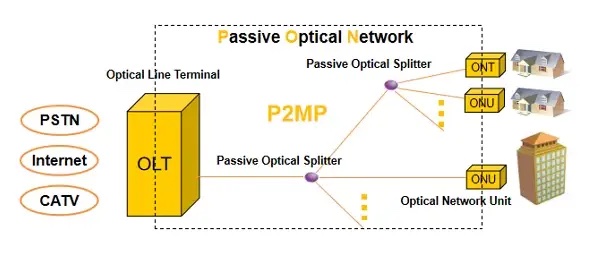
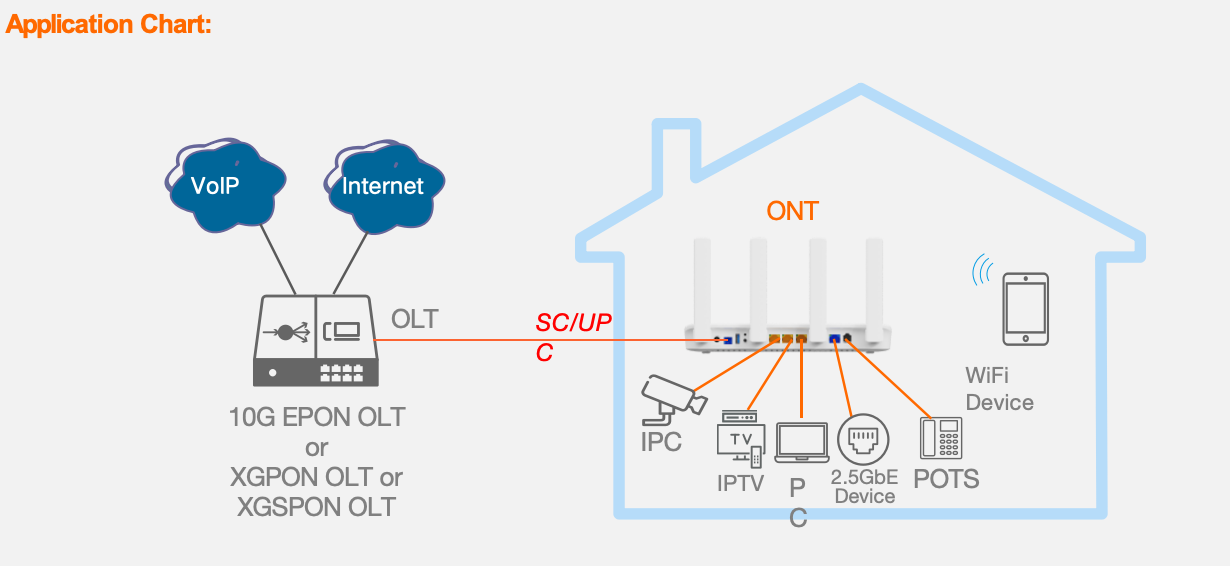
Every PON shares the same physical shape: an OLT at the central office or street cabinet, a tree of passive splitters in the outside plant, and ONU or ONT devices at the customer premises. What differs between generations is the line protocol, the line rate and the management system, and those differences decide what hardware you buy. In other words, the GPON vs EPON comparison is really a comparison of two standards philosophies. In the GPON vs EPON discussion, the two standards grew out of different worlds and still carry that heritage today.
EPON: The IEEE Standard
EPON (Ethernet PON) was standardized by the IEEE in 802.3ah and published in 2004. It carries native Ethernet frames, so it slots naturally into the Ethernet ecosystems that switches, routers and campus networks already use. Optics are comparatively simple and historically inexpensive, which helped EPON spread quickly in parts of Asia where Ethernet-centric operator networks were already common. A later amendment, 802.3av, defined 10G-EPON with 10 Gbps downstream and either 1 Gbps or 10 Gbps upstream. For operators whose whole transport plan is Ethernet, the GPON vs EPON choice often tilts toward EPON for ecosystem simplicity.
GPON: The ITU-T Standard
GPON was standardized by the ITU-T in the G.984 series. It wraps traffic in the GPON Encapsulation Method (GEM), which can carry Ethernet as well as TDM-style services, and it ships with a heavyweight management plane: PLOAM for the physical layer and OMCI for managing the ONU remotely. Line rate is 2.488 Gbps downstream and 1.244 Gbps upstream, with a typical split ratio of 1:64. Carriers favor GPON when they need granular QoS, per-service SLAs and centralized provisioning — reasons why GPON became the default FTTH standard for telco deployments across Europe, the Middle East, the Americas and much of Asia.
GPON vs EPON: Head-to-Head Comparison
Side by side, the GPON vs EPON trade-offs are easy to see:
| Aspect | EPON | GPON |
|---|---|---|
| Standards body | IEEE 802.3ah | ITU-T G.984 |
| Line rate (down/up) | 1 Gbps / 1 Gbps | 2.488 Gbps / 1.244 Gbps |
| Framing | Native Ethernet | GEM encapsulation |
| Typical split ratio | 1:32 to 1:64 | 1:64 (up to 1:128 in some builds) |
| Management | Ethernet OAM, simpler | PLOAM + OMCI, carrier-grade |
| Optics ecosystem | Low-cost Ethernet parts | Wider carrier selection |
| Typical reach | 10–20 km depending on split | Typically up to 20 km class |
Three points matter most in practice. First, capacity: GPON delivers roughly 2.5 Gbps downstream, so on the same split ratio it feeds more subscribers than 1G EPON before contention. Second, operations: OMCI in GPON lets the operator push profiles and upgrades to every ONU from the OLT, which large carriers care about more than integrators do. Third, cost: in a pure GPON vs EPON price comparison at the optical-module level, EPON parts have long been cheaper, though the gap narrows with volume. Neither standard is “better” in the abstract — the right answer follows your existing network and your service targets.
XG-PON and XGS-PON: The Ten-Gigabit Generations
Both GPON and EPON top out well below what modern bandwidth plans demand, so the industry built two 10-gigabit successors on top of the GPON family.
XG-PON: Ten Gigabit Down, 2.5 Up
XG-PON (ITU-T G.987) raises downstream to 10 Gbps while keeping 2.5 Gbps upstream. That asymmetry matches typical residential traffic, where downloads dominate. XG-PON was deliberately engineered to share an ODN with GPON: it uses different wavelengths, so GPON and XG-PON can run simultaneously over the same fiber and splitters while subscribers migrate at their own pace.
XGS-PON: Ten Gigabit Symmetric
XGS-PON (ITU-T G.9807.1) provides 10 Gbps in both directions. Symmetry is the headline feature for business services, mobile fronthaul/backhaul and increasingly for households running cloud backups and video calls in both directions. Like XG-PON, it coexists with GPON on the same outside plant, and today it is the de facto default for new FTTH builds in most markets. Combo OLT modules that carry GPON and XGS-PON on one port make migration nearly transparent.
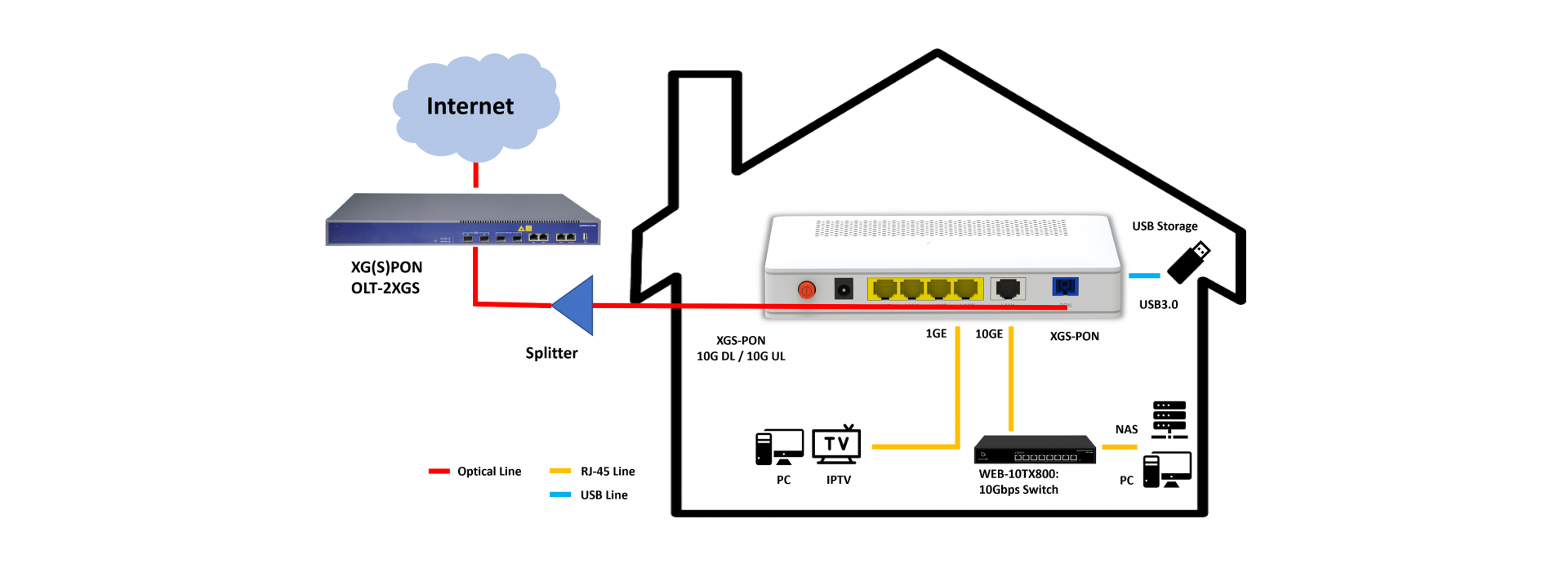
On the IEEE side, 10G-EPON offers an equivalent ten-gigabit upgrade path for operators committed to Ethernet, but the GPON family’s wavelength-based coexistence scheme has made XGS-PON the more common choice in telco FTTH rollouts.
All Four Generations at a Glance
Here is the complete GPON vs EPON vs XG-PON vs XGS-PON picture in one table:
| Generation | Downstream | Upstream | Coexists with GPON? | Best suited for |
|---|---|---|---|---|
| EPON (802.3ah) | 1 Gbps | 1 Gbps | No — same wavelength plan, needs extra filtering | Ethernet-centric Asian ISP networks, legacy builds |
| GPON (G.984) | 2.488 Gbps | 1.244 Gbps | — (the baseline) | Carrier FTTH, MDU/FTTB, general broadband |
| XG-PON (G.987) | 10 Gbps | 2.5 Gbps | Yes — wavelength overlay | Asymmetric residential upgrades |
| XGS-PON (G.9807.1) | 10 Gbps | 10 Gbps | Yes — wavelength overlay | New FTTH builds, business services, symmetric plans |
One caution: the figure above and most datasheets quote line rate, not the throughput a subscriber sees. After GEM framing, DBA behavior and contention on a 1:64 split, a well-run GPON typically delivers tens to a couple hundred megabits per subscriber in busy hours, while XGS-PON comfortably supports gigabit-class plans. That gap is precisely why operators are moving to the 10G generations rather than squeezing more out of 2.5G GPON.
Which PON Generation Should You Deploy?
The right choice depends on your scenario more than on any spec sheet:
- New residential FTTH, mainstream market: plan XGS-PON from day one, ideally with combo GPON/XGS-PON OLT ports so early subscribers can start on GPON and be upgraded by swapping the ONU only.
- Rural, low-density, cost-sensitive builds: GPON on a 1:64 split remains a sound and economical answer where per-subscriber demand stays modest.
- MDU and FTTB: GPON per building, upgraded later to XGS-PON, works well because each ONU aggregates many households and upgrades happen at the building, not per apartment.
- Business services and leased lines: XGS-PON’s symmetric 10G makes it the natural pick where upload matters as much as download.
- Existing EPON footprints: keep operating EPON where installed, or evaluate 10G-EPON optics before any migration; wholesale replacement of a working EPON network is rarely justified on specs alone.
Whichever branch of the GPON vs EPON decision you take, the passive side — splitters, drop cable, distribution boxes and pigtails — is identical across generations, which is why a well-built ODN is the most future-proof investment in the whole network.
Running Several Generations on One ODN
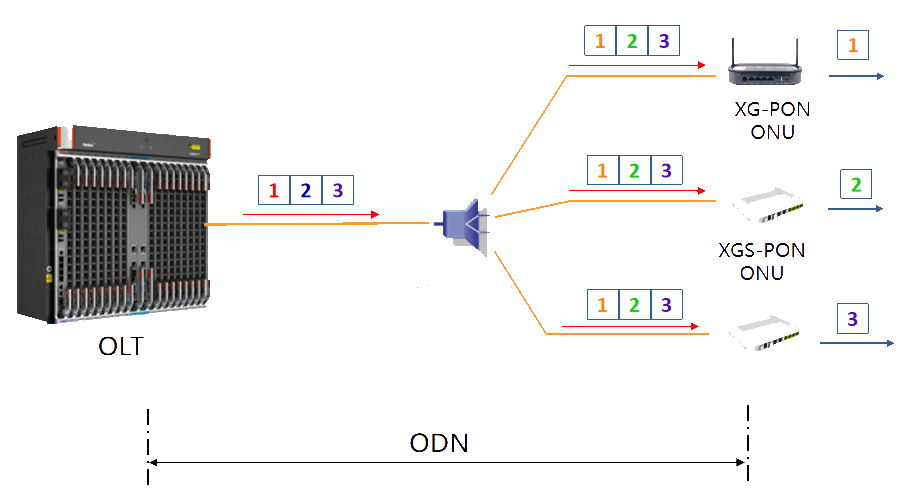
The most practical question in any upgrade is not which standard to pick but how to move without touching the outside plant. Within the GPON family the answer is built in: GPON, XG-PON and XGS-PON use different wavelength bands, and a WDM overlay (or a combo OLT module) puts multiple generations on the same fiber through the same splitters. For anyone weighing a GPON vs EPON upgrade path, that built-in coexistence is the single biggest practical difference between the two camps. EPON is the exception in a GPON vs EPON migration scenario: EPON and GPON share the same 1310/1490 nm wavelength plan, so running both at once requires additional filtering equipment rather than a simple overlay. That single fact explains most of the industry’s preference for GPON-family upgrades over cross-standard migrations.
FAQ
Is EPON outdated?
Not dead, but no longer the frontier. Large EPON installed bases keep running, and 10G-EPON exists for those who stay on IEEE rails. However, most new carrier FTTH projects specify GPON or XGS-PON, so the GPON vs EPON question increasingly becomes a legacy-maintenance question.
Can GPON and XGS-PON share the same splitter?
Yes. They use different wavelengths, so a WDM overlay or a combo OLT module lets both run on the same ODN simultaneously. This is the standard migration method.
What comes after XGS-PON?
NG-PON2 defines 40 Gbps-class systems via time and wavelength multiplexing, and 50G PON is in standardization. Both are real but still niche; XGS-PON is the practical state of the art for deployment planning today.
Final Thoughts
The GPON vs EPON debate has a clear modern resolution: EPON remains a capable legacy platform, GPON is the versatile 2.5G baseline that still fits countless deployments, and XGS-PON is where new capacity is being built. Because the optical distribution network is shared across all of them, the smartest move is to choose PON technology products from a supplier that covers the full chain — PON series products covering OLT platforms, and ONU/ONT products for the subscriber side — so your GPON vs EPON choice never locks you out of the next generation. Explore the PON product families above, or contact our team for a deployment-matched bill of materials.