
In Journey to the West, one of the four famous works in China, Sun Wukong has a magical spell called “Water Avoidance”. The 43rd chapter of the book reads: “The (walker) twisted the water avoidance formula and separated the waves.” Sun Wukong’s mouth can be unimpeded when he enters the water.
Nowadays, the plot in Journey to the West is becoming a reality. The first set of deep-sea photoelectric composite underwater wet plug-in connectors developed by the Xi’an Institute of Optical Precision Machinery of the Chinese Academy of Sciences (hereinafter referred to as the Xi’an Institute of Optical Machinery), together with the Institute of Acoustics of the Chinese Academy of Sciences, the Shenyang Institute of Automation, the Changchun Institute of Applied Chemistry, and Laoshan Laboratory, has recently passed the acceptance. It has been in normal trial operation in the deep sea of 1,620 meters for more than 70 days. This set of wet plug-in connectors can achieve “water tightness” according to requirements, not afraid of high pressure and corrosion interference of seawater, and “water avoidance tips” to achieve photoelectric transmission in the deep sea.
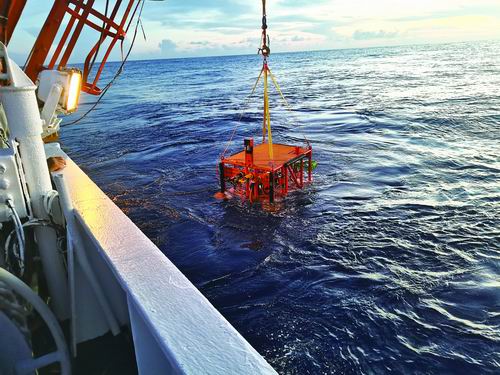
Running naked in the deep sea can still be dripping.
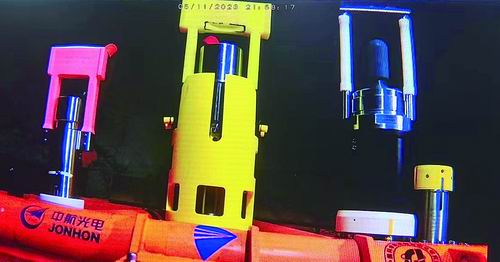
Why is it called “wet plug-in connector”? Wu Guojun, the person in charge of equipment research and development and director of the Marine Optical Technology Research Office of Xi’an Optical Machinery Institute, said that this set of underwater wet plug-in connectors is divided into two parts, which is equivalent to electrical plugs and sockets for home use. When carrying out underwater engineering construction, no waterproof measures are taken. One end is fixed underwater through connection stations and other facilities, and then the other end is inserted for combination.
“In the process of docking, it is necessary to ensure the conductivity of light and electricity, and maintain ‘water tightness’, that is, not to leak. After the connection is successful, it is also necessary to maintain ‘water tightness’ for a long time in this state. Wu Guojun said, so it is important to ensure that the connector can still be dripping in the case of “naked running” in the deep sea.
Because the core diameter of the optical fiber in the connector is very small, only 9 microns, any suspended particles in water may interfere with the optical fiber connection. Even if the error is only 1 micron, it will lead to a large optical fiber communication loss, which will not run normally. How to ensure that multiple fiber channels achieve synchronous and high-precision docking in the deep sea is the core problem to be solved by the team.
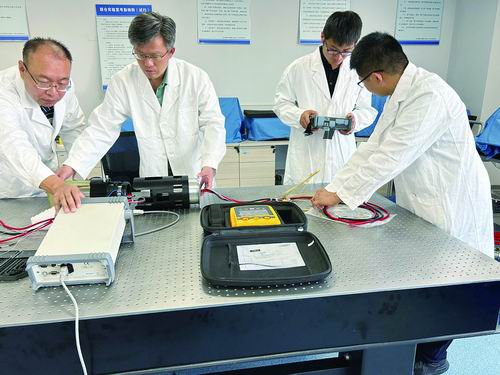
Because the core diameter of the optical fiber in the connector is very small, only 9 microns, any suspended particles in water may interfere with the optical fiber connection. Even if the error is only 1 micron, it will lead to a large optical fiber communication loss, which will not run normally. How to ensure that multiple fiber channels achieve synchronous and high-precision docking in the deep sea is the core problem to be solved by the team.
Wu Guojun and his team’s approach is to establish a channel throughout the docking process to play a completely “watertight” role, ensuring that the optical fiber can pass smoothly from one side and dock with the optical fiber on the other side.
Wu Yafeng, deputy director of the Marine Optical Technology Research Office of Xi’an Optical Machinery Institute, said that the team used oil filling to solve the problem. First of all, we fill the sealed box with special silicone oil to ensure the balance between the external pressure and the internal silicone oil pressure, and avoid direct pressure under deep-sea pressure. The sealing cavity is full of silicone oil, which also helps to protect the optical fiber and the electric core from direct contact with seawater. Wu Yafeng said.
According to the researchers, general large-scale underwater projects cannot be built as a whole, and need to be “thrown” into the water one by one to form. For example, when laying submarine optical cables, because in many cases, not only one cable is laid, many connection stations, main stations, connection boxes, submersible labels and other devices will be connected to the optical cable, so they can only be laid separately.
“We can put the part with the plug at one end of the wet plug-in connector, then put it on the other end, and finally connect the wet plug-in connector to provide energy and signal collection and transmission. Without it, many of our big deep-sea projects would not be possible.” Wu Guojun said.
Put a motorcycle on a person’s nail cover.
Relevant data show that the deepest record of human diving with equipment is 332 meters. The wet plug-in connector works in the deep sea of more than 1,000 meters, which is far beyond the field contact range of manpower, so it can only be operated by ROV manipulators. When the connector is wet plugged and unplugged, the manipulator can push the handle reserved at one end of the connector to push it to the other end of the connector to achieve the connection.
Deep-sea underwater operation is much more difficult than on land. During the connection process, in addition to the requirement of “watertightness”, the plug-out force of the manipulator is not too large. However, the difficulty is more than that. Ensuring accuracy is the biggest problem for deep-sea underwater connection.
The optical fiber achieves a connection accuracy of 9 microns, but the accuracy of the operator is not so high, which requires a large degree of redundancy in the operation, multi-stage guidance, and accurate docking through simple operation.
At the beginning, the team observed the leakage in shallow water, with low relative pressure and low risk. However, as the pressure increases, the friction will increase. The connector is a “dynamic seal” under water, which should solve the problems of pressure and friction at the same time. This is the place where Wu Guojun and the team are more “head scratching”.
This state cannot be imitated in shallow water. In order to complete the experiment, the team developed a plug-in device different from the robot. This device fixes the connector on the linear guide rail, ensures higher docking accuracy, and can be placed in the pressure tank to simulate the insertion process under a certain pressure.
Wu Guojun recalled that the state of the connector in all aspects of the pressurized tank was completely different from that in shallow water. During one test, due to a problem with the limit device, the connector passed by the guide rail and directly broke down. All the signals under monitoring went wrong. “It’s not that there is something wrong with the connector, but something wrong with the auxiliary equipment. It’s very depressing to have such a situation.” Therefore, in the subsequent simulation experiment, the research team “exquisitely carved” and constantly solved the problem. In the end, the sea test of the connector progressed smoothly, achieving the successful insertion and unplugging of 1,620 meters in the deep sea and the transmission of electrical energy and data. This deep pressure is equivalent to the weight of a medium-sized motorcycle on the human nail cover.
At present, the connector has been in normal operation for nearly 3 months, and Wu Guojun and his team have finally done it.
Significantly reduce the construction cost of deep-sea projects in China
It is understood that at present, almost all of China’s deep-sea connectors and related products rely on imports. A photoelectric composite underwater wet plug-in connector sold for a foreign company is 800,000 yuan, while a large-scale deep-sea project requires hundreds of connectors.
China has some research foundations in electrical connection, but optical connection is almost blank. This time, the photoelectric composite connector developed by Wu Guojun’s team solves the problems of light and electricity at the same time, and realizes the transmission of large-volume photoelectric signals, which can fully meet the needs of deep-sea work.
Since the problem of photoelectric transmission has been solved at one time, is this set of wet plug-in connectors in the leading position in the world? Wu Guojun said frankly that it has been studied internationally in the field of wet plug-in connectors for decades, and many problems are gradually exposed in the process of use and then continuously solved.
“Although the wet plug-in connectors we developed are running normally so far, the technical principles have been passed, and some core indicators have reached the level of international advanced products, but this does not mean that the reliability problem has been completely solved.” Wu Guojun told China Science News that this set of wet-plugging connectors can meet the requirements of use in the deep-sea environment, but the working time of the general connector is 20 years. Due to the different environments of the deep-sea and land environment, the high-pressure and salt-rot environment are always testing the material and structure of the connector, and its long-term reliability needs to be further Test and improve, the team will continue to carry out research in this regard.
Wu Guojun introduced that with this set of connectors, it is possible for China to use independent equipment to complete some large-scale underwater projects.
“This time, we have successfully developed the first set of photoelectric composite underwater wet plug-in connectors in China, which will provide key basic component support for China’s large-scale deep-sea projects, solve the risk that such products have been heavily dependent on foreign countries for a long time, and greatly reduce the construction cost of China’s deep-sea projects.” Ma Caiwen, director of Xi’an Optical Machinery Institute, said.
At present, the project has passed the acceptance, and almost all experts at the review meeting expressed their need to accelerate its industrialization. It is meaningless to put the results only in the laboratory, and the existing shortcomings can be improved in the process of industrialization and productization. Wu Guojun said.
China Science News (2024-01-30 1st edition Highlights)
Special statement: This article is only for the purpose of disseminating information, and does not mean to represent the views of this website or confirm the authenticity of its content. If other media, websites or individuals reprint from this website, they must retain the “source” indicated on this website and bear their own copyright and other legal responsibilities. If the author does not want to be reprinted Or contact us for reprint fees and other matters.