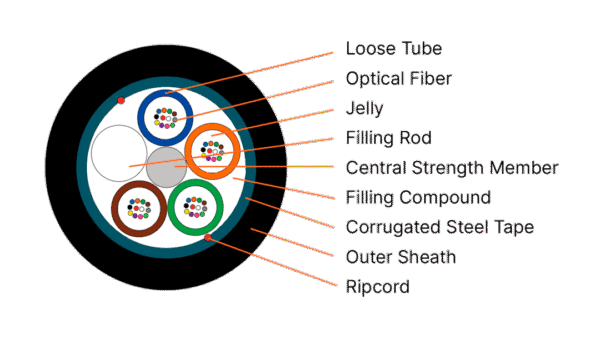
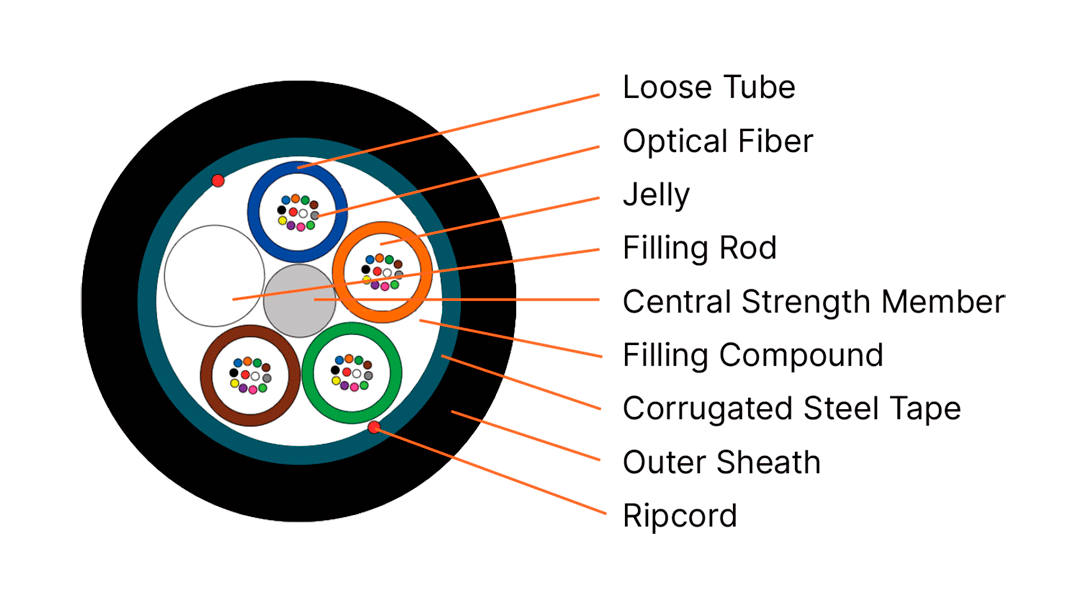
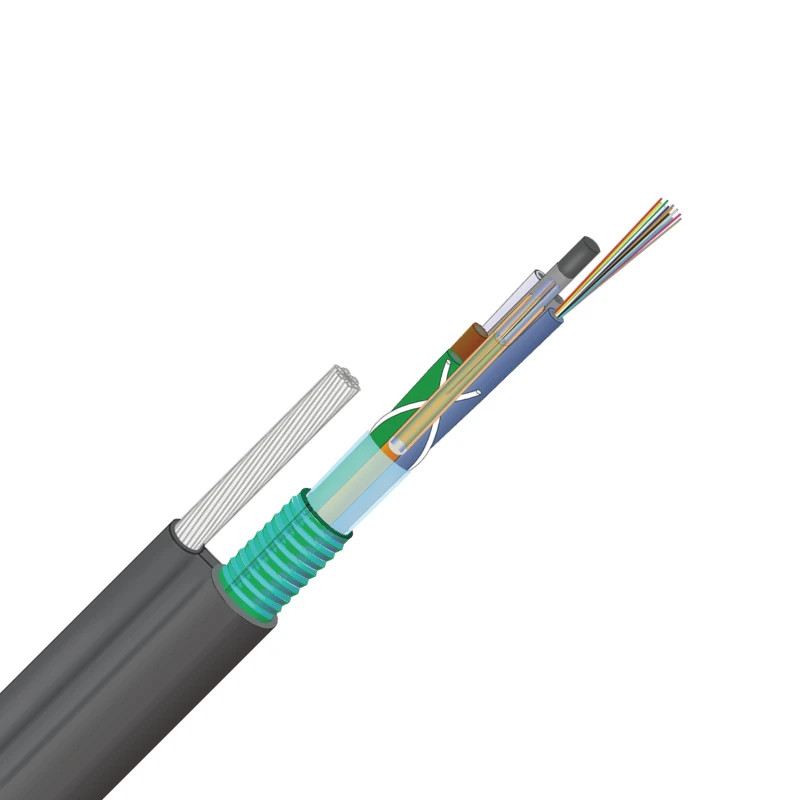
GYTS is a stranded loose tube outdoor cable with a metallic central strength member, jelly-filled tubes, water-blocking compound, two ripcords, steel tape armor and a PE outer sheath. It provides higher crush resistance than standard GYTA and is suitable for duct, aerial and light direct-burial routes.
GYTS is a stranded loose tube outdoor cable with a metallic central strength member, jelly-filled tubes, water-blocking compound, two ripcords, steel tape armor and a PE outer sheath. It provides higher crush resistance than standard GYTA and is suitable for duct, aerial and light direct-burial routes.
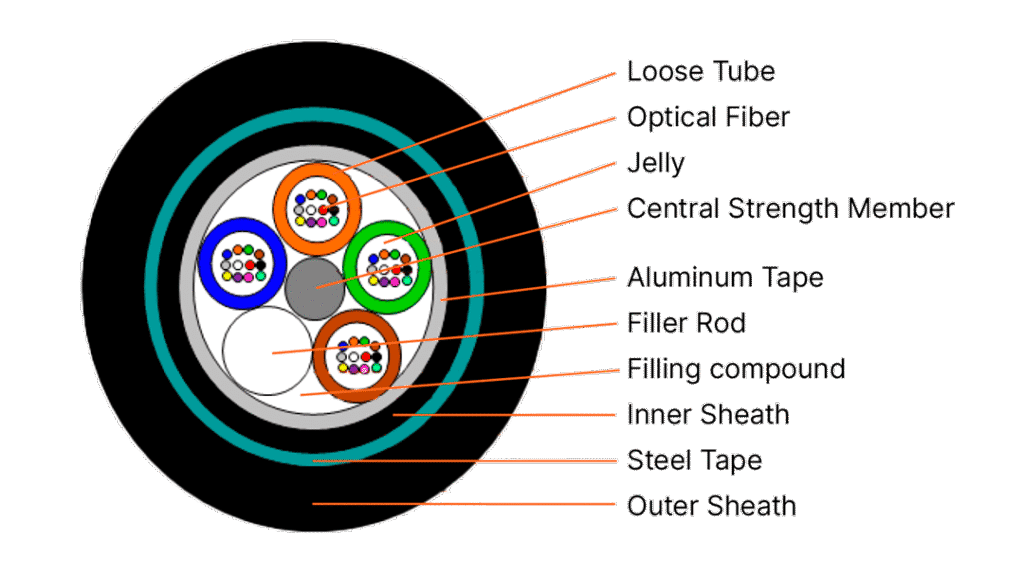
Stranded loose tube core with steel-tape polyethylene bonded sheath
Metallic central strength member with cushion where necessary
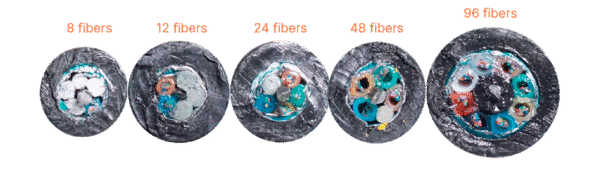
12 to 96 fibers with 1+5 or 1+8 element structure and 12 fibers per tube
Cable diameter 9.6-11.9 mm; weight 93-146 kg/km
Short-term tensile 1500-3000 N; breaking force 3000-4000 N; crush 1500 N/100 mm
Tested per IEC 60794-1-2 E1/E3/E4/E6/E7/F5/F1 for mechanical and environmental performance
| No. | 1 | 2 | 3 | 4 | 5 | 6 |
|---|---|---|---|---|---|---|
| Color | Blue | Orange | Green | Brown | Gray | White |
| No. | 7 | 8 | 9 | 10 | 11 | 12 |
| Color | Red | Black | Yellow | Violet | Pink | Aqua |
| No. | 1 | 2 | 3 | 4 | 5 | 6 | 7 | 8 |
|---|---|---|---|---|---|---|---|---|
| Color | Blue | Orange | Green | Brown | Gray | White | Red | Black |
| Item | Contents | Unit | Value | |||
|---|---|---|---|---|---|---|
| Fiber count | Number | / | 12 | 24 | 48 | 96 |
| Cable structure | / | / | 1+5 | 1+5 | 1+5 | 1+8 |
| Fiber No. per tube | Number | / | 12 | |||
| Loose tube | Number | / | 1 | 2 | 4 | 8 |
| Central strength member | Material | / | Steel wire with cushion when necessary | |||
| Outer sheath | Nominal thickness | mm | 1.6 | 1.6 | 1.6 | 1.7 |
| Cable diameter | ±5% | mm | 9.6 | 9.6 | 9.6 | 11.9 |
| Cable weight | ±10% | kg/km | 93 | 94 | 98 | 146 |
| Max. tensile load | Short-term | N | 1500 | 1500 | 1500 | 3000 |
| Breaking force | / | N | 3000 | 3000 | 3000 | 4000 |
| Item | Contents | Value |
|---|---|---|
| Max. crush resistance | Short-term | 1500 N/100mm |
| Min. bending radius | Installation | 20 x cable diameter |
| Operation | 15 x cable diameter | |
| Temperature range | Operation | -40°C ~ +60°C |
| Installation | -10°C ~ +60°C | |
| Storage/transportation | -40°C ~ +60°C |
| Item | Test Method | Acceptance Condition |
|---|---|---|
| Tensile Strength IEC 60794-1-21-E1 | – Load: Short-term tension – Length of cable: ≥50m – Load time: 1min | – Fiber strain ≤0.6% – Loss change ≤0.1dB@1550nm after test. – No fiber break and no sheath damage. |
| Crush Test IEC 60794-1-21-E3 | – Load: Short-term crush – Load time: 1min | – Loss change ≤0.1dB@1550nm after test. – No fiber break and no sheath damage. |
| Impact Test IEC 60794-1-21-E4 | – Points of impact: 3 – Times of per point: 1 – Impact energy: 4.5J | – Loss change ≤0.1dB@1550nm after test. – No fiber break and no sheath damage. |
| Repeated Bending IEC 60794-1-21-E6 | – Bending radius: 20 x OD – No. of cycle: 25 | – Loss change ≤0.1dB@1550nm after test. – No fiber break and no sheath damage. |
| Torsion IEC 60794-1-21-E7 | – Length: 1m – Twist angle: ±90° – No. of cycle: 10 | – Loss change ≤0.1dB@1550nm after test. – No fiber break and no sheath damage. |
| Water Penetration IEC 60794-1-22-F5 | – Height of water: 1m – Sample length: 3m – Time: 24h | – No water leak from the cable core of the opposite end. |
| Temperature Cycling IEC 60794-1-22-F1 | – Temperature: -40 °C ~+60 °C – Time of each step: 12h – Number of cycles: 2 | – Loss change ≤0.1dB/km @1550nm. – No fiber break and no sheath damage. |
| Item | Contents | Value |
|---|---|---|
| G.652D Optical characteristics | ||
| Attenuation | @1310nm | ≤0.36dB/km |
| @1550nm | ≤0.22dB/km | |
| Dispersion | @1288nm ~ 1339nm | ≤3.5ps/(nm·km) |
| @1550nm | ≤18ps/(nm·km) | |
| Zero-Dispersion wavelength | 1300nm ~ 1324nm | |
| Zero-Dispersion slope | ≤0.092ps/(nnm2 ·km) | |
| Mode field diameter (MFD) | @1310nm | 9.2±0.4μm |
| @1550nm | 10.4±0.5μm | |
| Cable cutoff wavelength λcc(nm) | ≤1260nm | |
| Micro bending Attenuation | @1550nm (100turns; Φ60mm) | ≤0.05dB |
| Link polarization dispersion (PMD Q ) | ≤0.1ps/km 1/2 |
What is the difference between GYTS and GYTA? GYTS uses a steel-tape polyethylene bonded sheath instead of aluminum tape, giving better crush and rodent resistance. What fiber counts are offered? Standard configurations cover 12, 24, 48 and 96 fibers. What is the crush rating? Maximum short-term crush resistance is 1500 N/100 mm.
Full manufacturer datasheet is available on request from PNA Fiber.
Contact PNA Fiber for OEM/ODM branding, customization, volume pricing and lead time.
Cable configurations vary by model. Refer to the specification tables above for fiber count, single-mode/multimode type and construction details.
Armored and self-supporting variants are designed for aerial routes; duct and buried types are also available. See the model-specific structure table above.
Yes. Custom lengths, jacket printing and packaging can be arranged. Contact us for a quotation.
PNA Fiber · FIBER OPTIC CABLE · pna-fiber.com

Reviews
There are no reviews yet.