
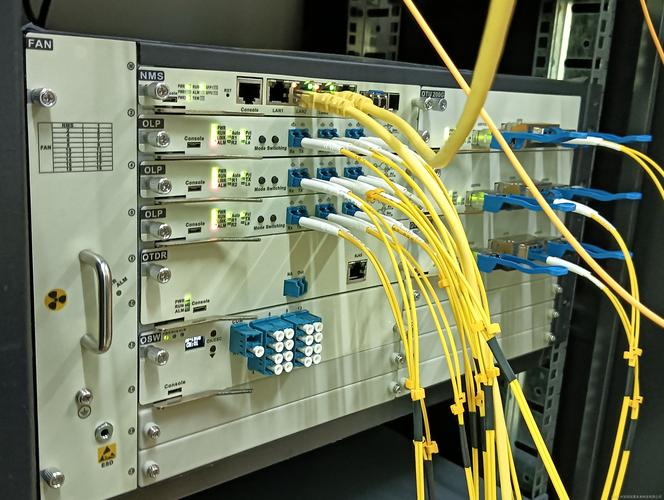
As one of the most basic components of optical network wiring, optical fiber patch cord (fiber jumpers) are widely used in the construction of optical fiber links.
Nowadays, optical fiber manufacturers have launched many types of optical fiber patch cord (fiber jumpers) according to different application scenarios, such as MPO/LC/SC/FC/ST optical fiber jumpers, single/duplex optic al fiber jumpers, single-mode/multimode optical fiber jumpers, etc., which have their own characteri stics and are irreplaceable. The following will introduce the common different types of optical fiber jumpers in detail to facili tate the selection and wiring.
According to the type of optical fiber connector:
According to the different optical fiber connectors, optical fiber jumpers can be classified as MPO / MTP / LC / SC / FC / ST / MTRJ / MU / E2000 / DIN optical fiber jumpers. Although these different types of fiber optic jumpers have similar components (composed of connector s and optical cables) and the same functions, they differ in application scenarios due to their diff erent characteristics and performance.
LC optical fiber jumper:
LC fiber optic jumpers are one of the most commonly used fiber optic jumpers in optical networks. Because they use LC connectors with a diameter of 1.25mm, they are small in size and very suitable f or high-density wiring, so they are widely used in computer rooms and data centers. Nowadays, in order to meet the high-density and high-performance requirements of data centers, many suppliers have launched LC fiber optic jumpers with better performance, such as ultra-low insertion loss LC fiber optic jumpers, one-tube double-core LC fiber optic jumpers, etc.
Ultra-low insertion loss LC fiber optic jumper: Compared with conventional LC fiber optic jumper (pl ugging loss is generally 0.75dB), ultra-low insertion loss LC fiber optic jumper adopts LL technolog y, and the insertion loss can be as low as 0.12dB, which is more suitable for long-distance transmis Sion.
One-tube dual-core LC fiber optic jumper: One tube dual-core LC fiber optic jumper adopts a special y designed LC uniboot connector, which allows optical signals to be transmitted in two directions in a single optical fiber, which can provide more possibilities for high-density wiring. Compared with the standard LC fiber optic jumper, it can effectively increase the space utilization rate by 50%, which not only saves time and cost but also makes wiring more convenient, especially su itable for places with limited space.
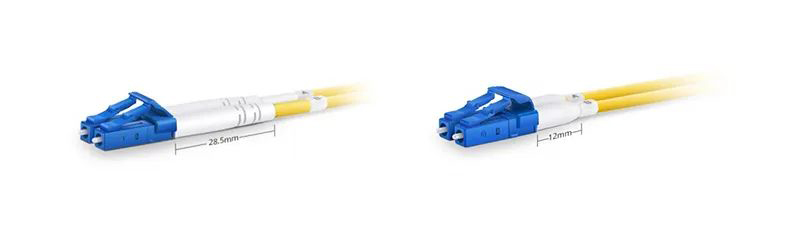
In addition, in order to save wiring space, compared with ordinary LC fiber optic jumpers, the short -tail sleeve LC fiber optic jumper adopts a 12mm short-tail sleeve design, and the length of the joi nt is shortened by 30%, making the wiring more flexible. It is very suitable for narrow environments and can meet the high-density wiring needs of MDA (main wiring area) and EDA (device wiring area). When space is limited, short-tailed LC fiber optic jumper is a good choice.
SC optical fiber jumper:
The SC fiber optic jumper adopts an SC connector with a diameter of 2.5mm, which is twice the size o f the LC connector, so it is also known as a large head connector (large head fiber optic jumper). The fiber optic jumper adopts a push-pull structure, plug-and-play, and has excellent performance. It is very suitable for telecommunications and data network systems, including point-to-point passiv E optical networks.
MPO/MTP optical fiber jumper:
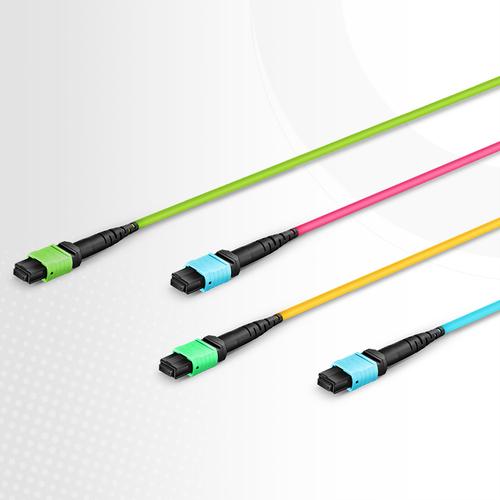
MPO/MTP optical fiber jumpers are one of the common optical fiber jumpers in high-speed data communi cation systems at present, such as 40G/100G direct connection and interconnection. MPO/MTP optical fiber jumper is a kind of optical fiber jumper with multi-core optical fiber connect or, which can accommodate 6~144 optical fibers, and is the largest optical fiber jumper with the lar gest capacity at present.
MPO/MTP optical fiber jumper is composed of optical fiber, sheath, coupling component, metal ring, p in (PIN pin), dust cap, etc. Among them, it is divided into polar A/polar B/polar C male/femal fiber optic jumper due to the diff erent types of optical fiber core arrangement position and pins. Due to the application of different types There are differences, so it is necessary to choose the ap Propriate MPO/MTP optical fiber jumper according to the actual link situation.
FC optical fiber jumper:
FC fiber optic jumpers are similar to coaxial cables, but there is no mesh shielding layer. The center is the glass core of light propagation. In multimode optical fiber, the diameter of the core is 15μm~50μm, which is roughly equivalent to th e thickness of human hair. The diameter of the single-mode optical fiber core is 8μm~10μm. The outside of the core is surrounded by a glass sleeve with a lower refractive index than the core To keep the optical fiber in the core. Outside is a thin plastic coat to protect the cover. At first, FC fiber optic jumpers were also used in telecommunications and data network systems, but With the introduction of LC fiber optic jumpers and SC fiber optic jumpers, they gradually withdrew From the market.
ST optical fiber jumper:
ST fiber optic jumper is a fiber optic jumper developed and manufactured by AT&T after FC fiber opti C jumper. The ST fiber optic jumper adopts a spring-loaded ceramic sleeve (2.5mm in diameter) with a jam-type connector, and the insertion loss is about 0.25dB. It can be used for long-distance and short-distance applications, such as campus networks, enterpris E networks, etc. However, in recent years, the market share of ST fiber optic jumpers and FC fiber optic jumpers has has been gradually declining.
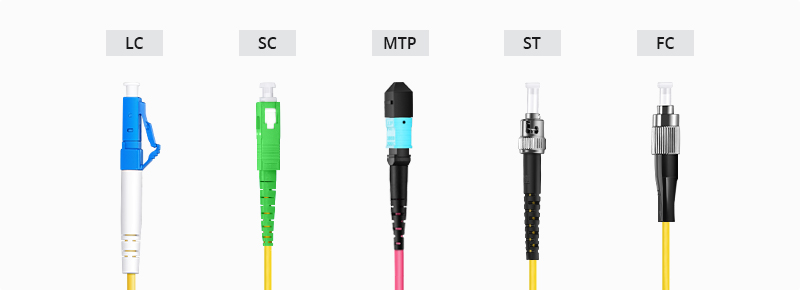
The five most common optical fiber jumpers mentioned above are currently the most common fiber optic jumpers, and their connectors and popularity are different. The following will introduce four types of optical fiber jumpers that are less used in today’s optic All networks.
MTRJ fiber optic jumper – The connector of MTRJ fiber optic jumper is made of precision plastic and is divided into male and female heads according to the different pins.
MU fiber optic jumper – MU fiber optic jumper is similar to SC fiber optic jumper. It adopts a connector with a 1.25mm diameter sleeve and a self-maintaining mechanism. It is compact, suitable for high-density installation, and can be used for DWDM networks.
DIN fiber optic jumper – Although the structural size of the connector pin and coupling sleeve of th e DIN fiber optic jumper is the same as that of the FC fiber optic jumper, the internal metal struct ure of the connector has a pressure-control spring, which is more complex and has higher mechanical accuracy, so the loss is small.
E2000 fiber optic jumper – The connector of the E2000 fiber optic jumper adopts a push-pull connecti on mechanism, and the automatic metal gate and laser beam protection device on the connector are ema Iled. The one-piece design can quickly realize terminal connection.
Scope of application:
Optical fiber jumper products are widely used in: communication computer rooms, optical fiber to hou seholds, local area networks, optical fiber sensors, optical fiber communication systems, optical fib er connection transmission equipment, national defense preparations, etc. It is suitable for cable TV networks, telecommunications networks, computer optical fiber networks a nd optical testing equipment.